
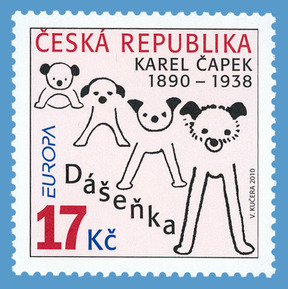
Theme of the stamp
This year's central theme for the annual EUROPA issue, announced by the Association of European Public Postal Operators PostEurop, is Children's Book. Dášeňka aneb život štěněte (Dashenka, or the Life of a Puppy) by Karel Čapek is one of the best known and most popular Czech books, not only with children. Karel Čapek was born in Malé Svatoňovice. His brother, Josef Čapek, was a famous writer, painter and photographer. Dashenka is an example of their frequent cooperation. After his studies, Karel worked as a tutor to the son of Count Lažanský, but soon took the position of a journalist, editing several newspapers: Národní listy, Nebojsa, Lidové noviny. He left the latter in 1921 as a protest against the sacking of his brother Josef by the paper's board. For the next two years he was a dramaturg at the Vinohradské Theatre. He was the first president of the Czech PEN Club in 1925-1933. He married his long-time friend, Olga Scheinpflugová, almost at the end of his life. After 1938 he became the target of political attacks. He spent the last years of his life in Stará Huť by Dobříš where he is still commemorated by a monument. He died of pneumonia, several months before his planned arrest by the Gestapo. Dashenka, or the Life of a Puppy is a book more than 70 years old. Iris, Dashenka's mother, was a wire-haired terrier living with Čapek. The book describes Dashenka's birth and early life until the day when she is carried away by her new owners, and a number of other stories (Stories for Dashenka, On Dogs' Habits, On People, etc.). The stories are accompanied by photographs of Dashenka, made by Josef Čapek. Karel Čapek wrote a large number of books, the major including War with the Newts, R.U.R., The White Disease, Krakatit, etc.
Method of printing
offset in red, blue and black