
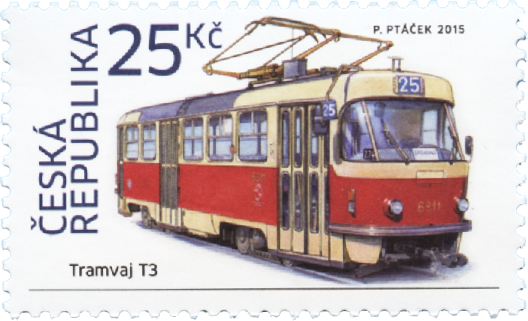
Theme of the stamp
The Tatra T3 is a Czechoslovak tram model manufactured between the beginning of the 1960s and the second half of the 1990s by ČKD Praha’s factory Tatra Smíchov.
The model was developed mainly because of the huge weight of the predecessor model Tatra T2, which was not ideal for smaller operators with poor-quality tracks. Thanks to its timeless design and high-quality construction, the new model became a synonym of the word “tram”. With over 14,000 cars produced, the T3 is the record holder in the number of manufactured units of the same model. Even today it is likely to be the commonest tram car in the world. At the time of its origin, it was one of the most modern vehicles using new materials, such as plastics and fibreglass.
The Tatra Smíchov factory supplied the Prague Transit Company with altogether 1,184 T3 trams. The T3 was supplied also to other Czechoslovak cities operating trams, with Brno (1963) and Košice being among the first customers. They appeared also abroad. The first customers were East Germany (today’s Chemnitz and Schwerin) and Osijek (now Croatia) and Sarajevo (now Serbia) in Yugoslavia.
The biggest customer was undoubtedly the Soviet Union. A staggering 11,353 T3 cars were delivered to 34 cities in the period of 1963-1987.
The first prototype (serial number 6101) was produced in 1960. Test drives started in Prague in the autumn of the same year. Normal operation started on 21 June 1961.
Although Czech cities began the process of decommissioning of the T3 in the 1990s, its upgraded version will continue to be used in Prague for decades.
The T3 tram is entered in the Guinness Book of Records as the most numerous type of trams in the world.
Method of printing
multicoloured offset