
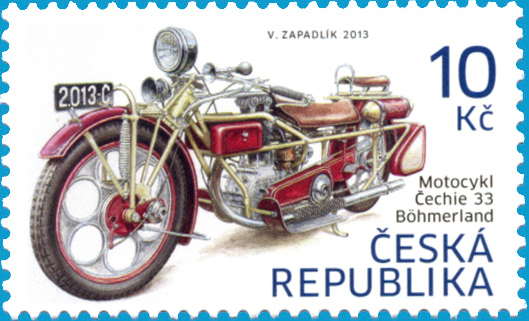
Theme of the stamp
The workshop where the first motorcycles Čechie-Böhmerland were built was set up in 1925 in Krásná Lípa by Albin Hugo Leibisch (1888-1965).
He began by building custom motorcycles. It took some time before they were made in series. The motorcycles with three seats and a 600 cc engine were used by small families instead of the expensive cars they could not afford. In the late 1920s, the popularity, reliability and cheap service of the motorcycles were such that Leibisch was unable to meet the demand. In 1931, he bought an old agricultural machines factory and launched series production. By the end of 1931, around 3,000 motorcycles were produced. The Čechie-Böhmerland met with embarrassed reactions. It was praised by some because of its price and reliability, and ridiculed by others pointing to the unusual engine design and aluminium wheels instead of the standard wire wheels. Together with Porsche, Leibisch was the first one in the world to use aluminium wheels. The long models were produced in series for the longest time in the world. From its beginning in 1925 to World War II, Leibisch produced five basic models; a “Langtouren” model, a short model, a super long 4-seat machine built for the military, a 350 cc model with a two-stroke engine launched in 1935, and a 700 cc model with a two-stroke engine launched in 1938. Today, only 75 Čechie-Böhmerland motorcycles are believed to have survived. 50 of them are in the Czech Republic, out of which 38 are in a good technical condition.
The minimum price of a well restored Čechie-Böhmerland is estimated at one million Czech crowns.
Method of printing
multicoloured offset